Project
CS-350: Data Visualization
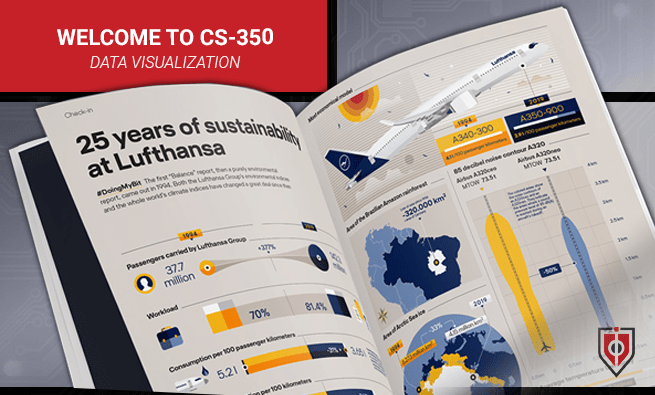
Client: Capitol Technology University Department: Computer Science (Undergraduate) Project Duration: 6 Months Course Longevity: 3 Years
Role: Instructional Designer
Course Overview
As the Instructional Designer for CS-350: Data Visualization, I was responsible for developing a course that challenges students who are already familiar with foundational programming concepts. Positioned later in the Computer Science program, this course encourages students to push their boundaries in a safe and structured educational environment, while introducing them to the dynamic and rapidly expanding field of Data Science. Below is a brief overview of the course description:
Course Description:
This course introduces industry standards and best practices for data visualization. Students will explore topics such as effective graphical representation of big data, unbiased data depiction, exploratory data analysis, and the creation of interactive and shareable visualizations.
Throughout the course, students engage in hands-on exercises using current programming libraries and tools. These activities are designed to apply the research and design principles learned, providing practical knowledge needed to create effective data exploration and explanation tools.
Course Learning Outcomes (CLOs)
To align the course with measurable outcomes, we developed eight Course Learning Outcomes (CLOs) based on Bloom’s Taxonomy. These are mapped to their respective Program-Level Outcomes:
-
CLO 1: Summarize and explain the fundamentals of information visualization, including user identification, tasks, and data, and abstract visualization problems into what, why, and how. (SLO 2)
-
CLO 2: Experiment with information visualization by abstracting the data (what), the tasks (why), and the methods (how). (SLO 7)
-
CLO 3: Interpret the visualization design space and principles, using marks and channels effectively. (SLO 7)
-
CLO 4: Visualize various data types (tabular, temporal, geospatial, tree, network) and implement relevant visualization idioms. (SLO 7)
-
CLO 5: Implement advanced visualization techniques such as faceting, coordinated views, pan and zoom, and embedded encodings. (SLO 7)
-
CLO 6: Evaluate visualizations through usability studies. (SLO 7)
-
CLO 7: Create useful and performant visualizations from large, complex datasets. (SLO 2 & SLO 7)
-
CLO 8: Design and construct visualization systems using cloud architecture. (SLO 2 & SLO 7)
Datasets and Repositories
We integrated several well-known datasets and repositories into the course to ensure the material remains relevant and up-to-date. Examples include:
Databases Used in the Course:
Additionally, students were encouraged to select their own datasets for specific assignments. This approach enabled instructors to assess students’ decision-making skills related to data quality, cleanliness, and sourcing, while also fostering creativity and independent thinking. By allowing this flexibility, the course introduced fresh and diverse datasets each semester, enriching the learning experience for both students and instructors.
This instructional strategy ensured that students were not only learning core data visualization concepts, but also gaining hands-on, real-world experience—effectively preparing them for the practical challenges they will face in the data science field.