Project
Applied Computing Learning Modules
Project overview
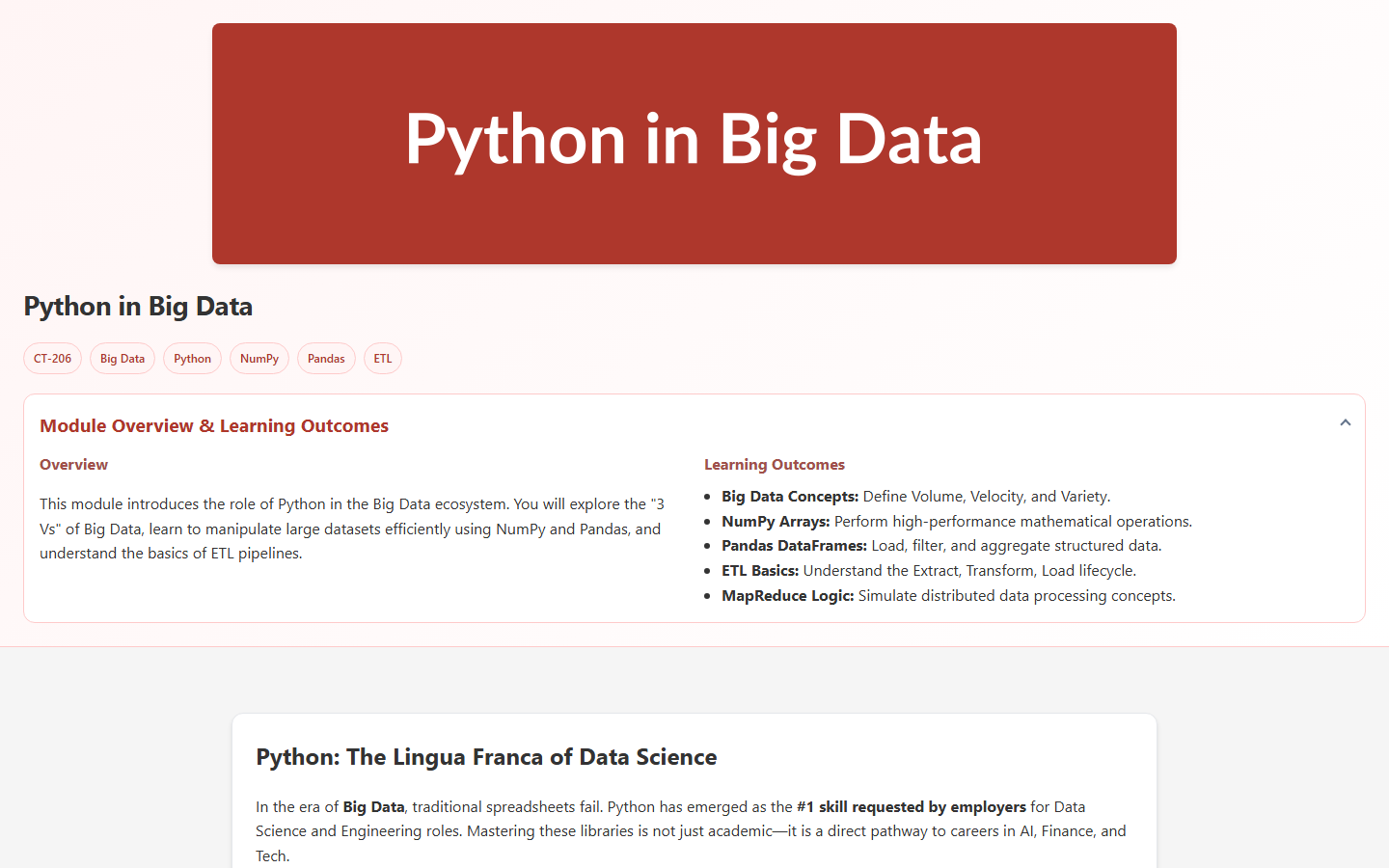
Applied Computing Learning Modules is a collection for interactive courseware that connects programming concepts to larger computing systems. The current public module, Python in Big Data, was created for CT-206 and introduces the role Python plays across a modern data workflow.
The work combines instructional design and eLearning development. Its purpose is not to reproduce a full programming environment in the browser, but to give learners a coherent mental model before they encounter the tools in code and assignments.
Only modules with working public demonstrations are included here. Additional CT-206 material will be added after its hosted artifacts have been restored and validated.
Audience and learning goals
The module is designed for undergraduate computing learners who know basic programming but may not yet understand how Python libraries fit into data engineering and analysis.
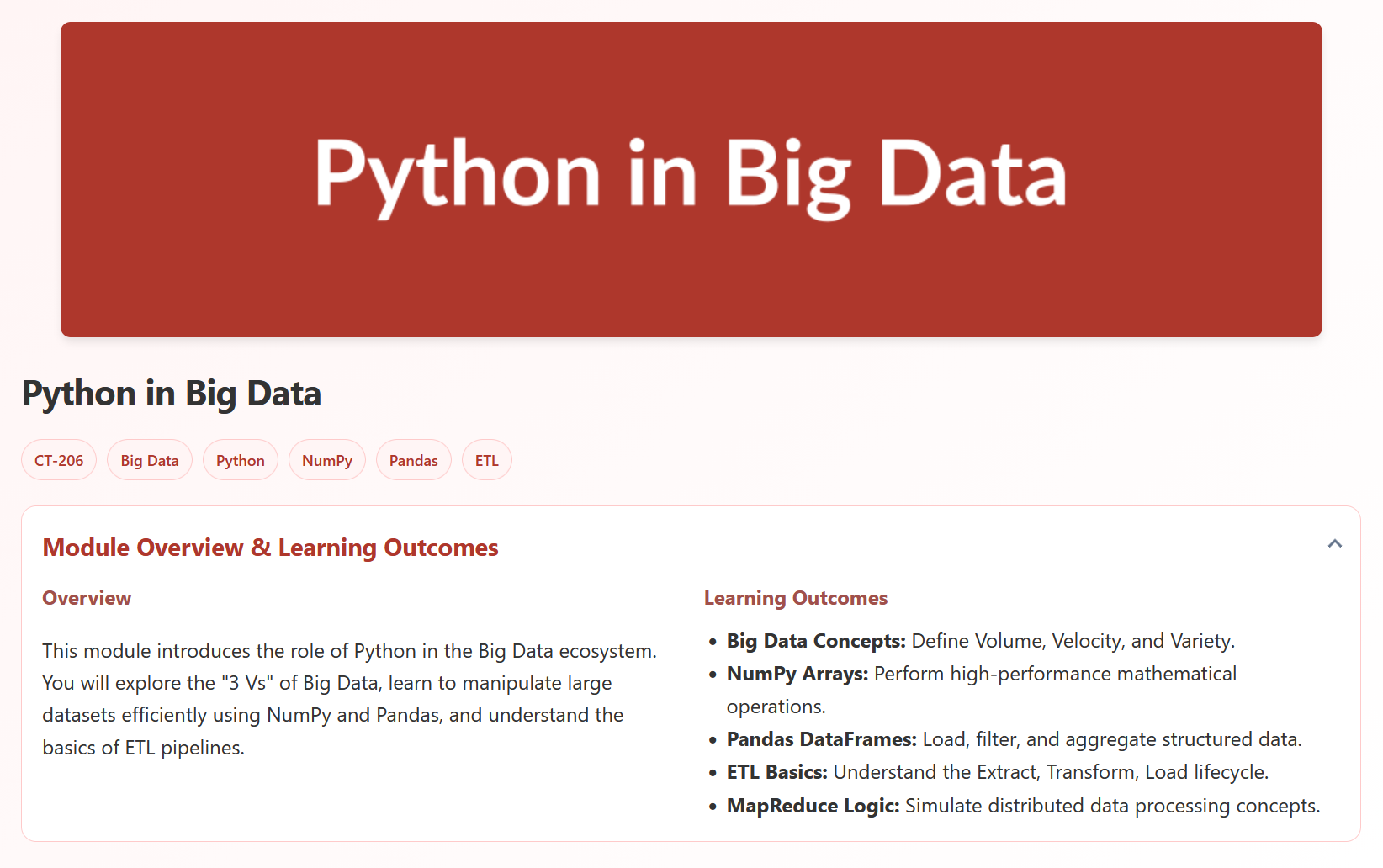
The experience helps learners:
- Explain Python’s role within the data-science and big-data ecosystem.
- Describe an extract, transform, and load pipeline.
- Distinguish NumPy’s vectorized arrays from Pandas DataFrames.
- Recognize when work must move beyond one machine into distributed processing.
- Connect library-level operations to a larger data workflow.
Learning architecture
The module follows the path data takes through a system rather than presenting libraries as an unrelated catalog.
- Python as an ecosystem: Establish why Python is used as an integration language across data tools.
- The data pipeline: Introduce ETL as the organizing workflow.
- NumPy: Explain vectorization and array-oriented computation.
- Pandas: Introduce DataFrames as a practical structure for transformation and analysis.
- Distributed thinking: Use MapReduce to show why larger datasets require different execution models.
- Knowledge check: Ask learners to distinguish concepts and select the appropriate tool or stage.
This order keeps implementation details attached to a system-level purpose. A learner encounters each library as an answer to a specific data problem.
Interaction design
The experience uses short explanations, diagrams, workflow transitions, and knowledge checks to manage cognitive load. It emphasizes comparison: array versus DataFrame, local processing versus distributed processing, and one pipeline stage versus another.
The module is delivered as a self-contained browser artifact, allowing it to launch from an LMS or directly from the portfolio without requiring a Python environment.
Open the Python in Big Data module
Constraints and next steps
An interactive explainer can establish vocabulary and relationships, but it cannot replace writing and profiling real data-processing code. The courseware is therefore designed as preparation for applied exercises rather than a standalone substitute for them.
Future additions to this collection must meet the same publication threshold as the current module: a working hosted artifact, an accurate written explanation, and enough context to show the instructional decisions behind it.